
My path into secular activism began during my time at the University Alberta, when I worked with a group of atheists and agnostics to challenge one of the school’s longstanding traditions.
Today, Canada is an increasingly secular and multicultural country, but its history is one of Christian hegemony. That influence permeates many of our institutions and they are often quite resistant to change.
As we found out, a small but vocal group can make some incremental progress. Those little, and often only partial, victories can reverberate through the culture and make the next, bigger change all the easier.
From Christian Beginnings
English Protestants and French Catholics colonized these lands and built our first institutions. We still feel their effects today: Most legislatures open with a prayer, “god” features in the national anthem and the Charter of Rights and Freedoms, religious groups are automatically deemed charitable and are exempt from property taxes, clergy can deduct their housing expenses from their income taxes, and many provincial governments provide public funding for religious schools and hospitals.
Canada’s post-secondary institutions are not exempt from this trend. Many of our most prominent universities were founded in the nineteenth and early twentieth centuries. This was a time when Canada was predominantly Christian, and other faiths, particularly Indigenous spiritualities, were suppressed. Unsurprisingly, then, many of those institutions included religious practices and symbolism in their founding practices.
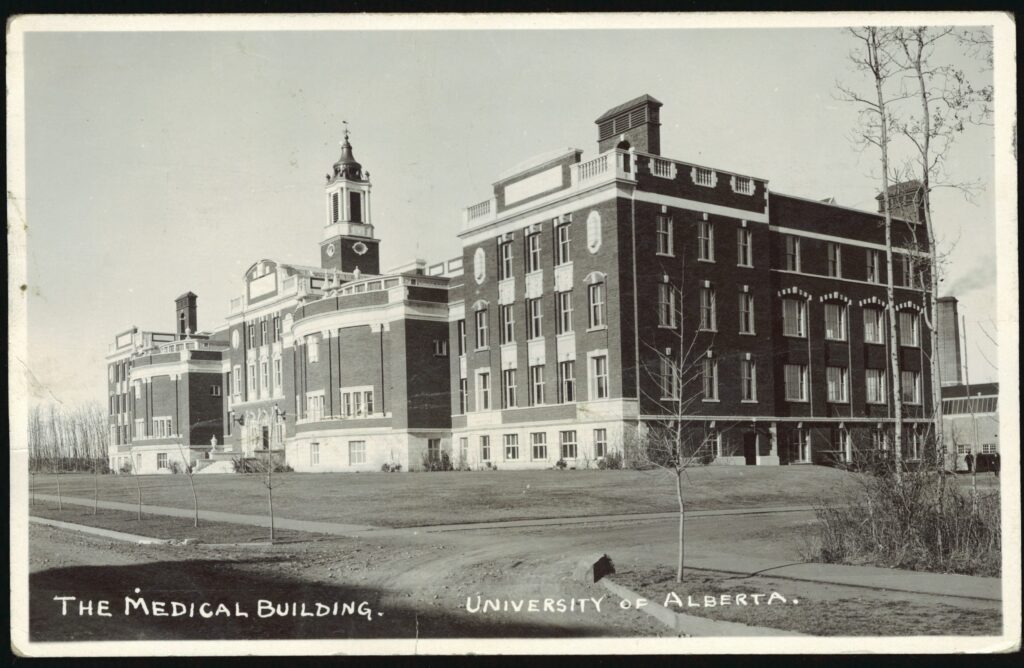
The University of Alberta was not exempt from this trend. The school included overt theistic language in its convocation ceremony. Graduating students were called on to use their degrees to glorify god. That language was still present in 2009 when I worked with a group of non-religious students and pro-secular allies to get the University to modernize the language.
The Convocation Charge
The University of Alberta was founded in 1908 in Edmonton, Alberta. The school’s founding statute set out:
“The university shall be strictly non-sectarian in principle and no religious dogma or creed shall be taught and no religious test required of any student or other person.”
Nevertheless, religion permeated the early University’s symbolism. The University’s motto, quaecumque vera, was taken from the Bible. And the convocation ceremony included a ‘charge’ read by the Chancellor that all graduating students shall use their degrees “for the glory of God and the honour of your country.”
A First Attempted Challenge
Most students would not know about the text of the charge until they were on stage and set to receive their degree. Paul Welke, who was set to complete his undergraduate degree in 2004, missed his convocation ceremony as he was deployed with the Canadian Armed Forces. The University offered Welke the opportunity to attend a later convocation and provided him a copy of the program. That program included the text of the charge.
Welke, an atheist, asked if the charge could be excluded from the program and raised the issue with the University’s Student Union. Together, they raised the issue with the University President’s Standing Committee on Convocation, but a majority voted to retain the theistic language. Given the religious wording, Welke chose not to attend convocation.
The issue remained dormant for a few more years until our group came along.
Enter the UofA Atheists and Agnostics

In the summer of 2007, I founded the University of Alberta Atheists and Agnostics (UAAA) with friends and other students I’d met through an Edmonton atheists meetup group. The New Atheist books of Richard Dawkins, Sam Harris, Christopher Hitchens and Daniel Dennett were bestsellers and early social media sites allowed fans and other atheists to connect.
Our group attracted an instant following. Hundreds of students signed up for our mailing list during the fall clubs’ fair, and we ended the year with 95 members, including a couple of faculty members.
Around this time, I met Welke through the meetup group, and learned of his previous complaint about the convocation charge. The UAAA executive launched a committee in December 2007 to revive the challenge.
The Campaign Begins
On July 14, 2008, we sent a letter to University of Alberta President Indira Samarasekera raising concerns about the language. We argued that religious references were “inappropriate” at a “public, secular institution.” We noted that the University of Toronto had removed similar references from its convocation the previous year, following advocacy by other secular activists.
The brief reply, which came in August, stated that the administration had recently considered the issue and, therefore, “the President does not wish to revisit the matter.” We requested a copy of the minutes from the relevant committee meeting but were told we would have to make a freedom of information request to access them.
Undiscouraged, we decided to ramp up public pressure. We created a Facebook group, “Secular Convocation at the UofA,” and launched a student petition demanding the removal of the religious reference from the convocation ceremony. We collected hundreds of signatures by tabling during the 2008 clubs’ fair and later in September at a table in the Students’ Union Building.
I also penned an article for the student newspaper, The Gateway, entitled “There’s no ‘God’ in graduation.” In it, I noted that the University of Calgary’s convocation was fully secular and that recent changes at the University of Toronto. I ended the piece by calling the administration’s dismissal of our concerns “abhorrent and intolerant” and a call “for a secular convocation at the University of Alberta and an end to the denigration of the hard work of all students.”
The Backlash
The article generated a wave of attention, including letters to the newspaper and emails to the club. Many of those comments were supportive, but others took our request for inclusion as an attack on their faith. Some of my phrasing in the article clearly struck a nerve, particularly the line, “It’s commonly understood that the big-G ‘God’ here is some variant of the monotheistic God (or the one Jews, Christians, and Muslims live in fear of).” I published much of the feedback I received on my blog, Terahertz Atheist.
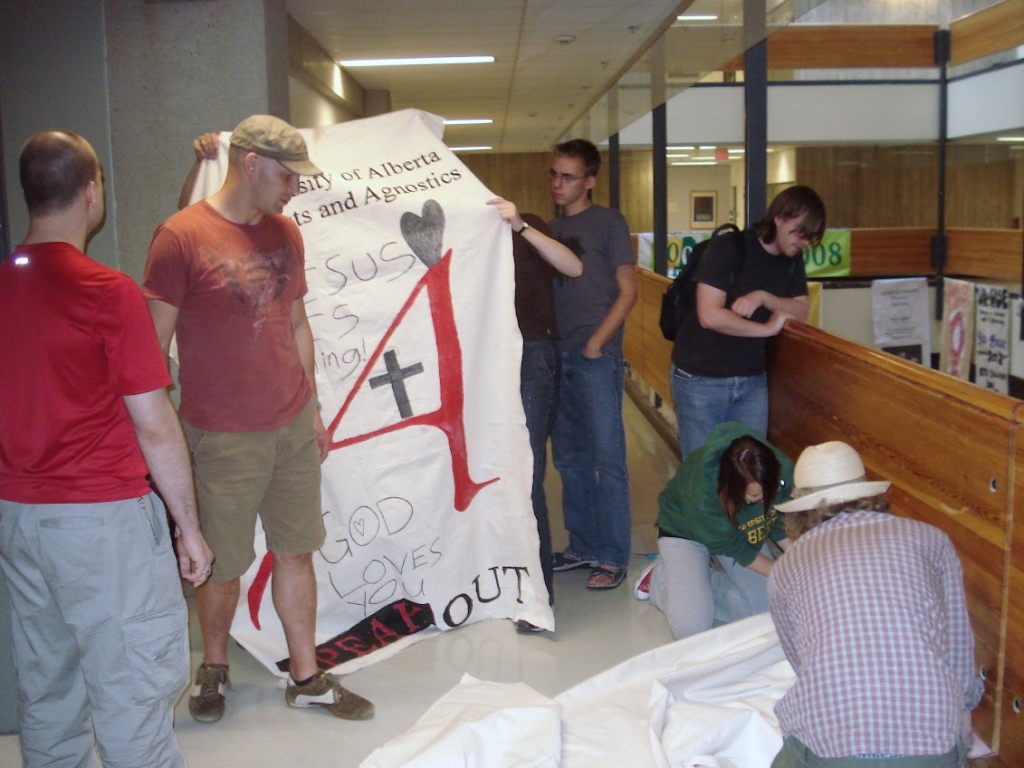
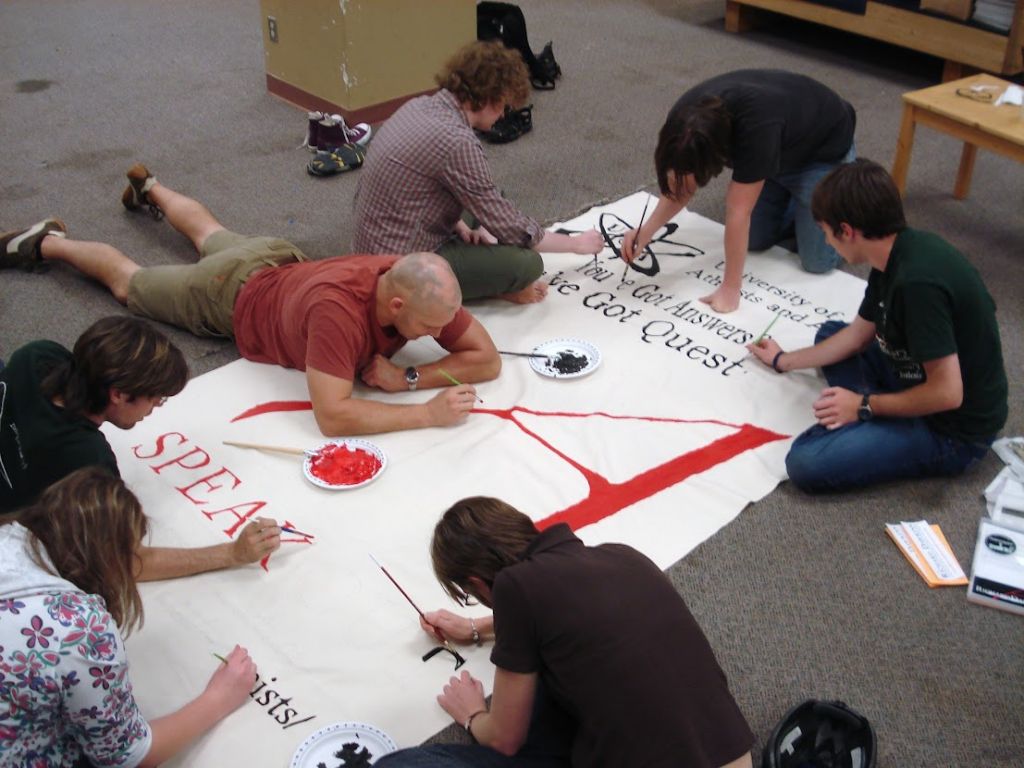
Among the more disturbing reactions, we discovered that the large UAAA banner that we had hung in the Central Academic Building foyer had been vandalized. Our members handmade the banner and we had hung it in the building, with permission, periodically since January 2008. However, over one weekend in October, someone pulled up the banner, cut off our website URL and email, and wrote “Jesus Christ is coming” and “God loves you” on the banner itself. They also drew a large cross on it. I hastily put out a press release about the banner and that generated another round of local news.
We ultimately turned that into a team-building exercise as our group came together to paint a new banner.
A Seat at the Table
In mid-September, a by-election was called for the General Faculties Council (GFC). This large body oversees the University’s academic and student affairs, including convocation. The GFC is composed of 159 members, including administrators, faculty, students and staff. Student representatives are elected annually, though often positions remain unfilled.
I applied to run for the vacancy to represent students in the Faculty of Engineering and was elected by acclamation on September 26, 2008. This gave me a seat at the table where the decision would be made. Another UAAA member, JD Crookshanks, was elected as a graduate student representative on GFC.
GFC convened a special meeting of its Executive Committee on October 27 to collect views on the convocation charge. At the meeting, Crookshanks delivered a petition from the UAAA and argued for a secular charge.
Another Round of Coverage
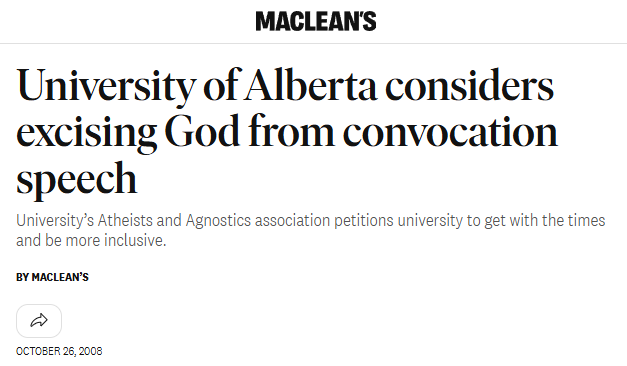
Our efforts were boosted again when one of our connections successfully pitched our story to the Edmonton Journal. The story ran a few days before the GFC Executive Committee meeting and was then picked up by other media outlets, including CTV and Global News.
This drew a lot more attention to our cause, which also triggered a stronger backlash. On October 27, the Edmonton Journal ran a full page of letters condemning the petition under the headline “U of A must reject secular convocation.”
Most prominent was an extended letter from the Lutheran campus chaplain, Rev Richard Reimer. Reimer wrote on behalf of the entire Interfaith Chaplains Association and called for “an inclusive convocation” that focused on “accommodation versus elimination.” He recounted how the Chaplains became aware of the Facebook group “when notified by a member of the university who was unable to express a candid opinion as an employee.” He recounts that “the skeptical among us asked whether the student club making the petition could truly speak for all agnostics and atheists on campus, since many are much more tolerant.” The latter claim deceptively shifts the need to display “tolerance” from those with power, the institution of the University and the campus chaplaincy, to those without, namely non-religious students.
The coverage extended nationally. I tracked the coverage from Moncton, NB, to Trail, BC. Perhaps the most surreal experience was when CH News Hamilton had me on their show to debate the issue with Charles McVety, President of Canada Christian College and Senior Director of the anti-same sex marriage Defend Marriage Coalition.
The Democratic Process
On November 3, the GFC Executive Committee (EC) meeting passed a resolution to “strike a subcommittee for the purpose of drafting proposals to change the wording of the ‘Convocation Admission’; to consult the University community on such changes; and to then report back to the GFC Executive Committee.” That committee, which first met on November 18, consisted of members of the GFC Executive Committee, Chaplain Reimer, several other administrators and UAAA member JD Crookshanks (on behalf of graduate students).
Those members were provided with various community submissions and tasked with presenting their own recommendations as well. Notably, Provost Carl Amrhein insisted that the group consider at least one alternative wording “that continues to make reference to ‘God’.”
Crookshanks told me that the voices on the subcommittee were split. Views ranged from supporters of a secular change to those who wanted a more religious approach. Crookshanks suggested incorporating language from the UofA’s founding documents that referred to the “uplifting of the whole people.” Another member suggested including, “for all who believe, to serve your God.”
Ultimately, the subcommittee provided four options to the Executive, ranging from religious to wholly secular:
“I charge you to use them…”
-
- for the uplifting of the whole people; to inspire the human spirit, to serve your God, and to pursue more steadfastly whatsoever things are true.
- for the uplifting of the whole people; to inspire the human spirit; for all who believe, to serve your God; and to pursue more steadfastly whatsoever things are true.
- for the uplifting of the whole people, to inspire the human spirit, and to pursue more steadfastly whatsoever things are true.
- to pursue more steadfastly whatsoever things are true.
The Executive opted for the second option as a compromise that maintained the theistic language, albeit with a caveat.
A New Charge is Approved
The issue came before the full GFC at its January 26, 2009, meeting.
As a GFC member, I spoke in favour of adopting a change and proposed an amendment to strike “for all who believe, to serve your God.” The President called on members to “vote against the amendment,” and by and large they did so by a vote of 30 to 59. Another member proposed adding “or goddesses” to the charge, which also failed. The initial proposal passed by a healthy margin of 71-10, with 10 abstentions.
The new charge would be read for the first time in June 2009, coinciding with the University’s 100th anniversary and my own convocation on June 11. I was pretty proud of that moment, as I was able to cross the stage after hearing language that I had fought for and won.
Watch the video (featuring me at 1:34:57):
The Charge Revisited
After that, I moved to Vancouver for grad school. I got involved in the SFU Skeptics and BC Humanist Association then and didn’t think much more about the UofA’s convocation charge. That was until I got a message from a reporter from The Gateway in 2017, who was doing an article about how the convocation charge had just been changed once more.
This time, the impetus came from Doug Stollery, who served as the UofA’s Chancellor from 2016 to 2020. Following his recommendation, students were now tasked with using their degrees “to serve your community for the public good.”
Stollery, who was previously chancellor of the religious St Stephen’s College, told The Gateway that he felt the ceremony should be more inclusive “of students of all faiths and students of no faith.” In his view, the UofA was founded as a secular institution, and its practices should reflect that. He wanted to be the Chancellor for all students.
I called Stollery for this article to discuss his experience further. In contrast to the public debate surrounding our efforts to enact change in 2009, he ran into little opposition. He told me he raised the change with campus chaplains over lunch, as well as the University’s president, registrar’s office, convocation committee and University Senate. After that, the change followed a similar but easier path through the GFC Executive and body. Rather than a vigorous debate, he said the response was a largely muted acceptance. Things that once seemed tremendously controversial, a few years later, were not.
The Wider Context
In the past twenty years, Alberta, like most of the Western world, has undergone a radical demographic change. The rate of religious adherence has plummeted dramatically. The number of Albertans reporting no religious affiliation in the Canadian Census rose from 26.6% in 2001 to 40.1% in 2021, while the number of Christians declined from 71.4% to 48.1% over the same period.
In other words, the province has gone from having nearly three Christians for every non-believer to near parity. By most metrics, non-religious rates are even higher among the younger and more highly educated, suggesting the student population of the University of Alberta is even less religious than those provincial averages.
So when Welke requested a change to the convocation charge in 2004, he faced an uphill battle against the Christian majority viewpoint. When the UAAA brought the issue up just five years later, the non-religious constituency was nearing one-third of the broader public. And by 2017, when the religious language was finally removed, Christians were on the cusp of losing their status as the majority viewpoint.
Amid these changing demographics, we also witnessed broader debates about the role of religion in government across the country. In 2015, the Supreme Court of Canada established the “state’s duty of religious neutrality” in finding that prayers said before a municipal council meeting were unconstitutional. That decision led most (but not all) municipalities across the country to abandon such practices. Similarly, a growing number of public institutions began to reflect on their own duty of religious neutrality.
Conclusion
While it’s easy to see the changes to the University of Alberta’s convocation as merely reflecting the broader growth in the number of non-religious Canadians, it took direct advocacy by students to effect that change. Our efforts involved mobilizing students and using multiple tactics to leverage the power we had available to us.
In the end, institutional inertia and opposition left us with an incremental result, reached via compromise. Nevertheless, having changed a 100-year-old tradition, we established the precedent that change was possible. This set the stage for the simpler change made a few years later by those in power who had come to share our perspective on the issue.
This gradual change, from overtly religious to secular, is reflective of the slow evolution of Canadian society. Canadian institutions tend toward incrementalism over revolution. This means activists should expect pushback and inertia in response to their demands. We need to be adaptable and willing to compromise, as today’s small change can help win the longer struggle.

Ian Bushfield is the Executive Director of the BC Humanist Association. He lives in Coquitlam, BC.
- Ian Bushfield
- Ian Bushfield